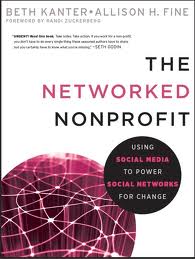
Book Review…The Networked Nonprofit

Beth Kanter and Allison Fine‘s book The Networked Nonprofit: Connecting with Social Media to Drive Change has been a very refreshing read. As someone looking to complete a dissertation on the impact of social media in nonprofit organizations, much of the research I have done already is pretty much summed up in this book. However, it is more practical and easier to read.

My last post about this book discussed some concepts that have been of particular interest to me and my studies. Specifically, the idea of organizational identity or image in the social media environment, successful social media use, and now as I have finished the book I have paid particular attention to the idea of sustainability. I also discussed this idea in another post. So with this minor book review I want to try to be clear that if you are a nonprofit administrator/staff person looking for understanding with the tweets, pokes, and updates, then this book is for you. I don’t want to give away the entire contents of the book, but there are at least 16 different strategies for utilizing social media. One of my favorites is network mapping. Simply put this is the concept of identifying who is in your network and how they are connected. Identifying the strong and weak ties among those connections present opportunities to build and deepen relationships with key constituents. This is the basic premise of using social media successfully, which is to build relationships that will provide for opportunities in the future.

I use the term successfully with some trepidation. Mainly because in the book the authors use effectiveness in several different ways. At times I wasn’t sure what the definition of effective social media use was. However, I am assuming that it is building that meaningful relationship that can be leveraged in the future. Effectiveness can be defined so many different ways, and even after asking the authors on Twitter (@Kanter @Afine), I still wasn’t sure. So hopefully I am capturing this correctly. My own bias is that effective social media use depends in part on the social media strategy. This is where I put on my critical theorist hat and declare that the book left out several key elements that could have further developed the principles and strategies the authors propose. I found myself at times wanting more information. I found bits and pieces of several theories that have provide the foundation of what they discuss, but don’t fully acknowledge as such. For instance, much of what the book proposes seems as though it is based off general systems theory, contingency theory, social exchange theory, and social network theory. Part of the muddleness (such a technical term) is due to the cross-pollination of those theories being informed by systems theory.

Okay, I know this might be somewhat nit picky, and I understand this book is written more for the nonprofit professional and not the nonprofit scholar. However, I can’t help but feel that what they propose as a networked nonprofit would be an excellent research design, and not just to confirm this idea, but to also identify and subsequently learn about the impact of social media in the nonprofit sector. What do I mean by impact? Think about how technology in general, and social media specifically, has changed our lives. It makes communication ridiculously easy, we are more accessible then ever, information sharing happens in an instant, and the list goes on. So how has social media impacted nonprofit organizations in these ways and others. The Networked Nonprofit presents case studies, but lacks the mistakes that these organizations experienced and ultimately learned from. That information is just as powerful as what actually worked. Furthermore, a case study is just that, a study of one particular case at one time, in one region. It’s not generalizable to other organizations.

One other area, again that is of particular interest to me and so now you may see my bias here, is the idea of sustainability. First off what does sustainability mean. The green movement? Well that can be part of it, but I am thinking more in terms of organizational sustainability, or what areas of the scholarly literature may discuss as organizational survivability. I view a sustainable organization as one that is able to keep its doors open to fulfill its mission. Sustainability has many dimensions as I have discovered from the literature to include but not limited to:
-Financial sustainability
-Program sustainability
-Leadership/innovation
-Strategic partnerships

The authors include the word sustainability, or a derivative thereof, 5 times. There is no definition of the term and again I am left to wonder if sustainability is about new donors, finances, relationships, or other? Again, I understand who the book is targeted at, but I think that some of these terms or concepts could be unpacked a bit more clearly to provide an ample framework with which to work. Then a nonprofit administrator could determine which parts of the text would be more beneficial to the organization at any given time. Working incrementally towards creating a networked nonprofit is a likely realization for many, as the proposed idea is somewhat of a radical shift in organizational culture that many organizations might not be able to handle.

In all fairness, the authors do make this point clear, that many organizations may experience some turbulence as they move to being a networked nonprofit. This is part of what I like about this book. It has just enough idealism and realism to demonstrate the possibilities of social media. In fact, I recently presented several ideas out of this text to a class on organizations and society at VCU. I hope the students like it 🙂

Well, I think this post is getting a bit long, hopefully you are still reading this, but at any rate I would definitely recommend this book to nonprofit administrators/staff, students, and others thinking about using social media in their organization. The strategies are clear, tools are provided, and examples demonstrate that ideas are limitless. I only wish I had enough time to use the Networked Nonprofit as a research design. Perhaps once I finish this little dissertation thing 🙂

You can find Beth Kanter’s blog here
and
Allison Fine’s here

What is a Sustainable Organization?

If you follow my blog then you know that I am in the process of writing my dissertation. Dissertating, as many doctoral candidates affectionately describe it, can be a tedious process with frustration, heartache, blood, sweat, and tears. Luckily for me, I am only experiencing some of those characteristics.

For the past month I have been trying to identify the critical domains of sustainability within nonprofit organizations that ensure continued operations amid a host of challenges. Upon swimming through the literature I have made a bit of headway in determining a few. I’m sure there are more but this is what I have so far:
-Financial sustainability- i.e. marketing, grant funding, social enterprise, fundraising (basically a diversified funding base)
-Programmatic sustainability- i.e. enacting successful programs that demonstrate quality and other factors requisite for continued funding.
-Strategic Partnerships- collaborations, mergers, and partnerships in a myriad of styles
-Leadership- strategy (this is almost a catch all) includes being innovative, effective governance, accountability, and transparency.

Now let me back up a little bit to define what I mean by sustainability, or a Sustainable Organization. I define sustainable organizations as those that are able to use their capacity for continued operations, programs, and generally keeping their doors open. Parts of the academic literature see this as survivability, but I think sustainability is more than survivability. Survivability to me conjures images of scraping by or trying anything possible to maintain, which can have adverse effects. I actually like the United Nations definition of sustainability as well. “Doing what is required to meet the needs of the present without compromising the ability of future generations to meet their own needs.” I think that this definition, however, lacks the necessary preparations for long-term sustainability. I see this definition as scraping by in the present, which often happens among many nonprofit organizations that don’t have the necessary capacity.

The The Jossey-Bass Handbook of Nonprofit Leadership and Management (Essential Texts for Nonprofit and Public Leadership and Management)
discusses the idea of the Sustainability chasm as the inability to adapt successfully to market pressures through technology, professional marketing, corporate partnerships, sophisticated fundraising, and complex government programs. I think this chasm exist not only because of the lack of sustainability planning, but because of a general lack of capacity. Capacity building has been identified as the process of developing and strengthening the skills, abilities, processes, & resources that an organization & communities need to survive, adapt, and thrive in a fast changing world. This sounds very similar to sustainability, doesn’t it?

The way I see it, capacity building happens in concert with sustainability planning. I say in concert because I think both of these ideas are a circular process. I would generally start with capacity building, but keep in mind the focus on sustainable practices/approaches. Once sustainability is thought to have been achieved, then begin thinking about another area to work on. But don’t forget that just because something is “Sustainable” means that you can forget about it. NO! You must continue to nourish it and work on the capacity side of it so that any environmental or market pressures do not force it to collapse or become useless. That is unless of course it needs to be let go, because sometimes programs may or should come to an end.

Okay, now that there is a clear picture of what I mean (or maybe now it’s about as clear as mud), how does this relate to technology and specifically social media? Several social media strategists (actually probably hundreds) will talk about many ideas like ROI, metrics, and cultivating relationships, which is all good, true, and desperately needed in the nonprofit sector. BUT I want to step back a minute and evaluate what I am calling “Readiness.” Well, I call it readiness right now, but there might be a better term for it, and feel free to comment with your idea 🙂

What do I mean by Readiness? Social media is still relatively new, and increasing numbers of nonprofit, for profit, and public organizations are beginning to adopt its use with out really knowing what it’s all about. Reasons include fear of being left behind, the potential to leverage networks and increase funding, volunteers, etc. etc…. However, I wonder whether these organizations are thinking critically about their adoption of social media? How to sustain a social media strategy? Whether they have the capacity to support a strategy? I believe that as an organization moves to implement the use of social media, they would be wise to engage in a strategic planning process based on these questions, or similar questions.

If you are using, have used social media, and are trying to implement where you are, you could be finding that it’s not as easy as it seems. I recently had a friend express some of his frustrations with this as his organization moves to adopt social media. The fact is for some it can be anxiety provoking, the idea of giving up control of the message, granting increased access through these new channels, and what about the TROLLS???? These are valid fears, and all the more reason that organizations need to think critically about their social media strategy.

As I move forward with my proposal for my dissertation, I am hoping to survey many nonprofit organizations about their READINESS. Questions may include:
-Do you have a social media strategy?
-Where do you hope to see the greatest ROI on your social media strategy?
-What is your plan to sustain your SM strategy?
-What was your process of implementation for social media?
-How do you measure the impact of your SM strategy?

These are just a few questions, and again, if you have more then please leave a comment. I would greatly appreciate diverse perspectives on this as it helps me to stay on the ground with my thinking.

My hope is that through my dissertation I will be able to find some value in moving nonprofit organizations to adopt social media in a more meaningful way. Stay tuned…

The Networked Nonprofit…Initial Reactions

I bought Beth Kanter and Allison Fine‘s book The Networked Nonprofit: Connecting with Social Media to Drive Change and have been reading it with wide eyed amazement. I have read many blogs and followed many social media experts on Twitter and Facebook who have discussed the ideas presented in this book, but nothing had ever been collected into one simple and easy to understand resource. Is it fair to say I am loving this book? YES! I wrote a paper for a doctoral seminar last spring and have been trying to conceptualize my own framework so that I can submit it for publication. I must say that part of what Kanter & Fine propose is very similar to my conceptual framework for managing organizational identity/image in the social media environment. Well, to be honest, I only propose a few concepts, but I am finding that I might need to rework part of my framework based on what they have written.
This is great, at least in my mind, because I see so much utility in being a networked nonprofit and embracing social media. Yes, I am a little biased. However, as I scrutinize this book a bit more closely I am beginning to come away with more questions. For instance, Kanter and Fine don’t provide a definition of effectiveness. What does it mean to use social media effectively? I think I know, but it would offer more clarity if they provided their own definition. Don’t get me wrong, the book is great and I would recommend it to any nonprofit administrator looking for help navigating social media, but I can’t help coming away a bit perplexed. Perhaps it’s my own fault having been immersed in organizational theory and such for my dissertation. I probably am over thinking it a bit. Yet, part of the book talks about taking a risk. In some respects, what they propose is a huge risk, and I’m not sure how many organizations can or are willing to take that kind of risk. Is there another way?
As I near the end of the book, I will provided a final review/reaction to the Networked Nonprofit. Mostly in hopes that Beth will weigh in and provide some critical insight that will help me with several ideas swirling around in my head. I know, I am so selfish. At any rate, if you haven’t checked out this book, do it! There are many gems of information contained therein.

Conceptual Framework

I just tweeted that I would write this blog update and so I thought I better get it done now or I might forget about it. So I wrote a paper for a doctoral seminar last year that I have decided to come back to, tweak, and try to submit for publication. The paper is about organizational identity and the use of social media to manage/maintain that identity. In short I have done some research and I continue to see from the blogosphere that many nonprofit organizations use or are trying to use social media for a host of different things. I have always wondered if any of these organizations, and some have, ever took the time to think critically about the organization’s identity and how that will take shape in the social media environment?

The paper I wrote is more of a conceptual paper and I am having trouble flushing out my framework. Here is a Rough draft of my framework with the concepts/ideas I plan on using. Conceptual Framework SM NPO Identity

I am basing the framework in Identity Formation theory, using a bit of symbolic interactionism, and calling for nonprofit organizations to critically think about three areas as they utilize social media. Those areas are Transparency, Accountability, and Authenticity. But I also don’t want to neglect the whole point about interaction, as this is crucial both in the use of social media, and in how image/identity is constructed. So I hope you take a minute to provide some input as I try to untangle my brain and provide something useful for nonprofit administrators to use.
Thanks.

Second thoughts on the Verizon iPhone

Although I currently have an iPhone and my service with AT&T has been great, I was still excited about the prospects of the iPhone going to Verizon. After today’s announcement, I would think twice about jumping ship or purchasing the popular device for several main reasons.

First off, the phone will not be able to run on Verizon’s 4G network. Well not until the summer anyway.
Second, which piggybacks on the first reason, is that the iPhone will likely be getting an update for a summer release. Hopefully then running on the LTE network.
Finally, and again because of the network, the iPhone will not be able to handle a phone call and running an app at the same time. For example, if you are talking with a friend about what movie you would like to see, you can’t jump to your speaker phone and pull up Fandango at the same time.

I know these issues WILL BE addressed in the coming months and iPhone will emerge better than ever. Yet, in the mean time, I am perfectly happy with what I have now. Besides, I’m locked into that 2 year contract and there is no way I am paying to get out of it 🙂

So before you purchase your Verizon iPhone, do a bit of research and see if you can’t wait just a few more months for an incredibly better phone.

Snnnzzzzzzz!!!! WHAT, WHERE’S MY ALARM????

I don’t know what to make of the fact that my first blog post of the new year is about the iPhone alarm mishap, but I just wanted to highlight this issue and the fact that the mainstream news media doesn’t really know what they are talking about. This morning marked the third day that my alarm didn’t work just as it didn’t work for many across the globe according to a report from Reuters. ABC news and other sources reported yesterday that Apple said the alarm glitch would be working as usual come Monday morning. It didn’t.

The problem I have is not so much with Apple as I continue to have faith in the company and I firmly believe that they get the publicity of these insignificant events because their products are so popular. My problem is that when a major news outlet reports on the mishap with their so-called technology guru and provide misleading information. I suspect they do so just because they know that Apple products are so popular that it will drive their ratings as people tune in to hear what’s going on with the glitch.

I just wonder why the Tech. news guru’s can’t use some of their own logic to report what may or may not happen. I mean I played around with the alarm on my iPhone 4 and even downloaded a few alarm apps. Nothing worked. I don’t profess to know everything about technology, but I figured that if the glitch didn’t work after two and half days, then it probably wouldn’t work without some sort of an update or patch downloaded from Apple. Thankfully, I used an old-school alarm clock to get up this morning, even though I don’t have to be to work today 🙂 So if the experts on the news stations can’t figure it out, I don’t think they should report on it as they do. But that’s not likely to happen.

This is the main reason I get information from multiple sources. I watch the news, read the paper (online), but also get most of my news through social media. In the coming year I suspect we will see even more of the mainstream media news outlets turning to social media to report on things rather then doing the legwork themselves. I don’t know if this is a good or bad thing, because I feel like if they use social media, they don’t often take into account that there are many viewpoints and they may only take one or two, which could be misleading.