This semester I have been engaged in teaching my Social Media, Digital Activism, and eCitizenship course in the traditional face-to-face format (previously it was completely online). This class was also selected as an iPad class, so each of the students either brought their own or were provided an iPad to augment their learning. One of the requirements of the course is to use Twitter to extend our conversations and learning outside the classroom. I have incorporated many assignments and skills from other social work educators, such as Dr. Laurel Iverson Hitchcock (@laurelhitchcock) and Dean Nancy J. Smyth (@njsmyth), as well as using New Media Literacies to help students understand social media. I am always trying to think about how to engage my students in hands on learning through experiential methods. This has involved the use of games, both low tech and high tech, and other methods as well.
This semester I have been more and more intrigued by the fact that the Nielsen Media Analytics Group has been tracking and reporting on the behavior of individuals who Tweet while they watch Television. Essentially, they discovered that Tweeting during a television broadcast can influence the ratings of that particular show. This study confirms many suspicions I have had about Twitter and in particular the integration of the Hashtag (#) on television broadcasts. Many television shows, news broadcasts, and even religious broadcasts now incorporate the use of the hashtag on the screen so viewers will tweet what they watch while they are watching and thus engage in a discussion about the show. This gave me the idea to incorporate it into my class while we watched the documentary Pink Ribbons Inc.
This documentary is very well done and if you haven’t seen it, I would encourage you to find it and watch it.
The directions I gave to students were fairly simple. I asked them to share their thoughts, reactions, and or quotes from the documentary using the course hashtag (#SOWK388) on Twitter. I thought this assignment would help them to stay focused on the documentary instead of simply snoozing through the two day event (not to say that students sleep during class, lol), and I knew that some of the students already used Twitter when watching some of their favorite shows, so I figured it would be fairly natural. The results were spectacular. My one regret is that I waited to long to archive the tweets using Storify, otherwise I would share them here.
During the course of the documentary, I followed the course hashtag on Twitter and would also tweet my own thoughts/reactions while at the same time responding to other students with questions and comments to push their critical thinking deeper. At the end of the documentary, I still held an in-class discussion but I was able to go back to Twitter to draw students into the discussion by highlighting their tweets and asking them to expand upon their thoughts and comments. This was by far the best in-class discussion of the semester.
The main takeaway for others who may want to adopt this in their course is to think ahead of time to organize the activity. The idea honestly only hit me the week before we viewed the documentary in hopes of encouraging interaction among the class. The next time I do this, I would like to get the students to also track the Twitter conversation while they view the documentary. There are multiple ways of doing this, from having them use a social media dashboard on their iPads (such as HooteSuite) to also getting an additional screen to display the conversation on Twitter in real-time in the classroom. Although, this might be more distracting for some students. I think asking the students to Tweet a reflection at the end of the period and the end of the documentary that sums up their reaction to the documentary and other’s tweets would also enhance the in-class discussion. Of course the students need to be set up on Twitter and understand the practice of using the Hashtag (#), but I also think archiving the conversation with Storify or some other service would also help students to reflect on the assignment/process. I’m sure there are several other products that could add to this assignment, so please leave a comment below.
In the end, I completely understand that some think the act of multi-tasking makes us less effective. I myself am not much of a multi-tasker for this very reason. However, I think this assignment helped to keep students engaged in the documentary and thinking about what was being conveyed because they needed to think critically about how to share their reaction in less than 140 characters of text (because that is all that Twitter allows). I was so amazed at the level of attention and critical thinking that students shared in relation to the content of the documentary, and I am certain that this assignment also helped students to grasped other concepts in the course as I would later use this assignment as an example in my teaching.
I don’t know that this would work for every class, because not every class is equipped with the technology, but if you plan on using something like this please come back here and share your results. I am very excited about how this assignment turned out and I hope that by sharing my experience others will also get excited to experiment with learning and share their experiences with me. As always, thanks for reading/following my blog and feel free to leave a comment or connect with me via Twitter.
This is a really quick post to bring some attention to an article that was recently published in Advances in Social Work. The article is title “A Conceptual Understanding of Organizational Identity in the Social Media Environment” and can be found on the publishers website. I also tend to keep a list of my work (and I try to keep it updated) over on my Academia.edu profile. Mainly, I wanted to draw other’s attention to this journal because I believe it is an excellent journal, and it is an Open Access Journal. Anyone can access the articles and use the information, which the main reason I really like this journal. Additionally, the peer review process and turn around time was excellent. I received some great feedback that I believe made the article much stronger, so thank you to the peer reviewers. Feel free to check out those links and let me know what you think about the article. It was definitely a process and result of several years of study and interaction in with social media. I think looking back at the structure of the article my main goal was to help those individuals unfamiliar with the idea of organizational identity, but who could understand individual identity and identity development, and to take them from the micro to the macro of identity. Situating this concept in the social media environment was certainly the main crux of the article, but I do think that these theoretical terms can help one to grasp the concept more easily. But again, feel free to let me know what you think by leaving a comment here, email, or connect with me on Twitter.
This post is mainly to serve as a supplement to a presentation given at the Council on Social Work Annual Program Meeting in Dallas, Texas (2013). Dr. Laurel Hitchcock (@LaurelHitchcock) and myself (@Jimmysw) shared with others how we use Twitter in our courses. The presentation involved explaining what Twitter is, as well as some of the symbols, meaning, and context that are often associated with interacting in the online space. The presentation also utilized a Prezi, which can be viewed by accessing the presentation link:
I would also point you to a blog post I authored on New Media Literacies, which I personally believe that new media literacies need and deserve as much attention as thinking about the ethics of social media and social work education (more on that later).
From the presentation abstract, we explain that Social workers need to be aware of and adept at using social media as part of their professional practice with clients and systems.
Social media includes applications and technologies on the World Wide Web and on mobile devices which create interactive dialogue among organizations, communities, and individuals (Richardson, 2006). There is a growing awareness that social work practitioners, students and educators need to be adept at using social media and technology as part of their practice and interaction with clients of all system sizes (Getz, 2012; NASW & ABSW, 2005; McNutt, 2008; Perron et al, 2010). Social media offers an opportunity for social workers to communicate and advocate around social justice causes, network with other professionals, and locate information and resources that will inform practice with clients. This workshop will cover how three social work educators from different parts of the country are using Twitter, a micoblogging platform, with their students in the classroom, and then how they collaborated to bring their students together via Twitter to engage in professional conversations about current topics relevant to social work practice.
Assignments and classroom tasks using Twitter help students learn about technology tools and resources available to communicate and interact with other professionals, and to stay informed about social work practice over time (Greenhow & Gleason, 2012). Students benefit from using Twitter in two important ways. First, they learn to communicate with professionals and each other in a new ways. Using the parameters of Twitter (140 characters), students can easily share information with each other and their instructors about group assignments, research studies and current events. Students also report the ability to communicate directly with social work practitioners and researchers via Twitter, and thus become more capable about how to communicate and interaction with professionals. While some students use Twitter for recreational or personal reasons, they can also learn how use the character limit, professional terminology and written skills to communicate in public ways using Twitter. Second, student learn to discover, disseminate and evaluate information related to important social problems and social work practice in new and very public ways. For example, one of the presenters has students assess the quality of practice-based information received via Twitter, and then share this information with the instructor, each other and other professionals over a semester. Classroom discussions about the Twitter assignment focus on topics such as privacy, public image, professional communication skills, becoming a life-long learner, and using social media as a way to give back to the profession, and reinforce the role of values and ethics such as social justice, competency and integrity in social work practice. Additionally, students learn how to approach and complete assignments that are publicly oriented (Jarvis, 2011). These examples demonstrate how Twitter can be used to address the educational policy and accreditation standards set forth by CSWE (2008). Specifically, students were able to engage in research and communication by discovering, interacting with and or engaging with different populations (EPAS 2.1.6 & 2.1.9). Additionally, students used critical thinking and creativity (EPAS 2.1.3) to engage in the policy discussion.
Recently, the presenters conducted a live Twitter event as a collaborative effort between their universities to discuss gun violence and gun prevention. This was the First live multi-university social work Twitter Chatand the archive of the chat can be accessed by clicking here. The purpose of the live chat was to demonstrate how social work students and educators can use technology to enhance policy analysis, macro practice, and online advocacy. Students were given instructions on how to participate as well as ground rules similar to those used in a group therapy session. At an appointed time, the presenters, their students and other social work practitioners “met” on Twitter to discuss a series of questions related to the gun violence. One of the presenters served as the moderator and used other social media tools such as HootSuite (to live stream the chat), YouTube (to record a video for future analysis) and Storify (to archive the discussion). The moderator closed the live twitter chat with a poll question to assess the reaction of the students who participated in the event. Out of the 30 people who answered the poll, over 70% stated they enjoyed the experience and felt it enhanced their learning.
Social work educators need to learn about and start using social media tools; not only to be role models for our students, but to facilitate discussions about the social work profession in a very public way. Twitter represents only one way in which social work educators can and are using social media in their classrooms. The literature is growing in regards to this area and much work still needs to be done.
Special thanks are in store to our esteemed colleague Deona Hooper (@DeonaHooper) at socialworkhelper.com, who assisted in facilitating the Twitter chat event and put together the Storify Archive. Deona wasn’t able to make it to CSWE, but her contribution has been invaluable.
Feel free to leave a comment or you can always tweet 😀
Getz, L. (2012). Mobile App Technology for Social Workers. Social Work Today, 12 (3), 8 -10.
Greenhow, C. & Gleason, B. (2012). Twitteracy: Tweeting as a new literary practice. The Educational Forum, 76(4), 464-478.
Hitchcock, L. & Battista, A. (2013). Social Media for Professional Practice: Integrating Twitter with Social Work Pedagogy. Journal of Baccalaureate Social Work, Vol 18 Special Issue.
Jarvis, J. (2011). Public Parts: How Sharing in the Digital Age Improves the Way We Work and Live. New York, NY: Simon & Schuster.
Perron, B. E., Taylor, H. O., Glass, J. E., & Margerum-Leys, J. (2010). Information and communication technologies in social work. Advances in social work, 11(2), 67-81.
Rheingold, H. (2012). Net Smart. Cambridge, MA: The MIT Press.
Richardson, W. H. (2006). Blogs, Wikis, Podcasts, and Other Powerful Web Tools for
Classrooms. Thousand Oaks, CA: Corwin Press.
I was pretty amazed this weekend to find that I, along with many other wonderful and amazing colleagues were listed as Top Social Work Professors on Twitter. You can see the list here. I thought I would provide just a bit of a post to welcome any new visitors who may have stumbled upon this blog as a result of seeing the list and the link to this site. Welcome. I hope you find something of value here and please don’t hesitate to email or tweet me if you have any questions. Thanks for dropping by. J.
I really should have mentioned back in May that I would be leaving on a summer hiatus for several months. Well, I am back into the swing of a new semester with course prep., advising, and faculty meetings. This also means I need to buckle down and get back to my research. I just wanted to post very quickly that I am still writing up the results from the New Media Literacies Survey I conduct in the Spring. I will post some preliminary results here on my blog so be sure to check back. If you don’t know what I mean, you can catch up here. If you took my survey, thank you again.
The semester is now over and I am reflecting on my iPad course, as well as looking through some of my anonymous comments from students. I have yet to get my actual course evaluations but I did have students volunteer to complete an exit survey on their experience of learning with the iPad. I will share a few tidbits as I am hoping to get this written up and submitted for publication. I have a previous post about my initial thoughts on learning with the iPad, which you can find here. I also wrote up a post about an iPad specific assignment that I created for the course, which you can find here.
In the previous iPad blog post I shared that I was excited for my class to have the iPads for learning. I was also realistic in regards to knowing the literature and using new technology in the classroom. Some have argued that students today are more adept at using technology than their instructors. However, as Apostolos Koutropoulos points out in his Digital Natives: Ten Years Afterarticle, this is more myth than reality.
My final thoughts on the iPad in my Policy course are probably best viewed with an eye of skepticism. I am a technology geek and love using Tech in the classroom. Especially a Policy course since most social work students dread policy. I say skepticism only because the reactions to the ipad were fairly mixed. Most students indicated that the iPad was very helpful for learning because they were able to search for information in real-time. If a student had a question on a Policy that I couldn’t answer, we searched the Internet and had a discussion about what we found. Students loved the fact that they could work on their group projects remotely and at various times. Students also indicated they liked being able to access course information easily and contact me as their instructor through email or twitter. Yes I used Twitter in this class, which could be another blog post in and of itself.
On the other hand, some students indicated that the iPads were a huge distraction during class. Although many students initially were using their iPads to take notes, some indicated they often would get distracted playing games or going on Facebook. I too was frustrated with this aspect of the iPad, as I indicated in my previous post. I also noticed that students began to revert to their laptops and other technological tools towards the end of the semester. When I asked why, they indicated that it was easier to type on the Laptop and that the Laptop seemed to be more reliable. I think that because students also were given the iPad MINI that it was more difficult for them to type on the smaller screen.
My FINAL THOUGHTS on the iPad are that I really enjoyed having the iPads in the class most of the time. I think that as anyone adopts a new innovation that there will be a learning curve associated with it and that one should think critically about how to incorporate new learning tools in their classroom. This is something I have been researching, writing about, and discussing with many others for years now. The need to think about how to incorporate new tools rather than just adopting them because they seem innovative. I was lucky that I was able to get the iPads in my classroom. However, it was on such a short notice that I know I could have done a better job with assignments and class activities that utilize the iPad if I had more time to think about it.
To sum it up, would I use iPads in my Policy course again. YES!!! Am I going to use the iPads again next semester? NO!!! Fortunately or perhaps unfortunately for the Policy students… I have requested that the iPads be taken from my Policy course and be issued to the students in a new course I just developed here at UNK. The course is titled Social Media, Digital Activism, and eCitizenship. The course draws upon an interdisciplinary perspective of marketing, nonprofits, and advocacy. It also relies heavily on New Media Literacy and of course Social Media. I will try to blog about it later. At any rate, I am glad that the University is innovative and forward thinking enough to invest in new technology and allow faculty to experiment. I hope that we will continue to be able to do so but with an eye towards making the learning experience better. I know that in social work we need more exposure to technology and to keep an open mind about how technology impacts our profession, our clients lives, and education. After all, it’s not going away!
If you follow me on Twitter then you know that I have already sent out a link about this study I am conducting. However, I also wanted to share this brief blog post as it relates to my sampling strategy for this study. You may recall a post several months back about Participatory Culture and Web 2.0 for Social Work Education. This study is the next phase of my work so I hope you will join in. Here is some more information with the link below.
You are invited to participate in a survey entitled, Assessing New Media Literacies in Social Work Education. The purpose of this study is to understand the relationship between media literacy and digital participation among social work educators and students. Specifically, this study will increase understanding regarding the use of information and communication technologies such as social media, while testing the validity and reliability of a newly developed assessment tool for self-reported media literacy levels.
Your participation is very important and the survey should not take more than 15 minutes of your time. You are being asked to complete an online questionnaire asking about basic demographics, digital participation, civic engagement, and new media literacies. You will be presented with a series of statements about media use, which will help determine your media literacy skills. At the completion of the survey, you will receive a score indicating your level of new media literacy.
Your participation is in this survey is completely voluntary and your consent will be assumed by your participation. You are free to decide not to participate in this study or to withdraw at any time without any adverse effects or penalties. Your decision about whether to be in the study or not is completely voluntary, and confidential. This study is not collecting any personal or identifiable information and risks to participants is minimal. The alternative to this study is simply to not participate. If you have any questions about the survey, feel free to contact the investigator at the contact information provided below.
To access the survey and find out your New Media Literacy Score, clink the link.
UPDATE: The survey has closed and you can read more about this work on my blog. Be sure to check out this link here.
This post is mainly a follow up to a recent twitter chat I had with @laurelhitchcock about my iPad Policy course. Specifically she had asked about ideas for using iPads along with Wikis. If you have any suggestions, please leave a comment.
First off, I currently do not use Wiki’s in this course, although I definitely could and I see the pedagogical value in doing so. Pooling information/resources into a share space, collaboration, communication, and many other skills and benefits students could gain from this tool. I am doing something similar, that is gathering resources and information, however, I am using a different tool. I will also not be using this tool again the next time around. Here is a description of my assignment from my syllabus:
Social Bookmarking assignment: Throughout the course of the semester we will collectively gather social media resources or digital apps and advocacy/analysis resources that relate to Policy and or Programs. Utilizing the social bookmarking website Diigo, each student is responsible for finding, evaluating, and discussing two resources. Students will need to provide links to articles on advocacy strategies or links to the identified resource on the course blog by the due date. Each student will discuss the resource they found in class by the date their assignment is due as well as sharing your resource using the course hashtag #swpolicy410 on twitter.
This is where I could insert the * about using Technology for any given purpose. I really like social bookmarking and find the use of Diigo incredibly helpful….from a desktop or laptop. The mobile app is almost useless, but they do have a diigo browser app that adds in a bit more functionality for the iPad. I created a diigo group, to which each student has become a part of, and in this space we collectively bookmark information/resources/digital apps that relate to our course content and educational learning. So far it is going pretty well. Why then will I NOT use this app again?
Mostly because of the lack of functionality on the iPad. Next time around I will either use Pinterest or Spring Pad. I am more familiar with Pinterest, yes guys do use Pinterest, but I like the fact that SpringPad allows me or any user to take photos of things out in the world and share to my pads. I will be experimenting with this as a information gathering and dissemination tool in the future, but for now we are sticking with Diigo.
There are some Wiki apps available for the iPad, but unfortunately I have not really used them. I found this post by LifeHack that might help those wanting to use Wiki’s on their iPads.
The other ways I am incorporating the iPad into Policy is through the Policy Advocacy project. This is a semester long project that encourages students to identify a policy or issue and create an awareness campaign. I have been hesitant in providing too much direction regarding this assignment because I want students to be creative in what they develop and ultimately employ. I have sprinkled out some ideas as far as using digital storytelling methods and using social media, but I really want this to be organic and develop from the students perspective.
One last tool that I use in this class that makes use of the iPad directly is online quizzes using the app Socrative. I do have some issues with this app, mostly that I can’t weight my quiz questions, but for the most part it is really useful and cuts down on the amount of paper I would typically use for quizzes in class. Each week students take a quiz over the chapter we just covered. I create the quizzes on the app and when students come to class I push the quiz out to their iPads via the app. It is really fairly simple. I can see live results so I know exactly when each student is finished with the quiz. The app then generates a report which is sent via email and I can open using excel which I can than save into my grade book.
I will be back later on to detail more about my experience of using iPads in the Social Welfare Policy course. Feel free to leave a comment or suggestion. I am always open to new ideas and methods of how to make Policy more interesting and meaningful for students.
Well I am over 3 weeks into the new semester and more specifically into my Policy class, which has been selected as an iPad class this semester. I haven’t shared much about this as it was really a pretty quick process of applying, getting approval, and revamping my syllabus to address learning with iPads. I hope that as the semester continues I will come back to my blog here and share some of my initial insights. I do have plans to conduct a small evaluation of this project, so details on that will be forthcoming. For now, some initial thoughts as I am almost done with January.
When my course was selected I admit that I was over the top excited for my students. I was excited because I love integrating technology into my courses and being able to have an iPad mini for each student just seemed fantastic. I also kept reminding, and still do, myself that just because I was excited and thought about how each student will use the iPad to augment their learning and bring in relevant policy examples into our class discussions because they have access to the internet in the palm of their hand…That just because of all the potential I imaged, that it did and does not mean my students feel the same. The truth is, and the literature supports this notion, that many students are mystified and nervous about using technology in the classroom. I have asked my class and so far the sentiment of anxiety holds true. Partly for the fear of breaking or losing this free device, and partly because they recognize that they have never used a tablet for learning. I have tried to ease the anxiety by finding and sharing as many resources as possible about the iPad and how to use it. Mainly in the form of YouTube videos embedded in my Blackboard course. I think it has helped but time will tell.
I still have hope that some of the assignments I have designed to maximize the use of the iPad will yield positive learning outcomes, but again time will only tell. I am still excited for the potential that these devices have in my class but I am also quickly realizing that I have my work cut out for me. That is the idea of challenging students’ thinking regarding learning with the iPad. Yes, I do have many students Facebooking through class or checking email or whatever. I don’t plan on implementing a policy stating they have to put the iPads away and pay attention, because the fact is that many students are using their iPads to take notes. I also think that if they are that bored in my class, then I need to engage them more in the discussion directly. I have them using twitter and it is fine if they tweet during class. I have to just keep reminding them to identify the relevance to the course as they do so. This is perhaps one of my first learning moments, which I expected but did not fully recognize. This idea, again, that I need to change their perspective in regards to how to use the iPad for learning rather than just entertainment. Don’t get me wrong, entertainment is good, but I think it can also be educational. Stay tuned for future updates 😀
This post is largely to serve as a follow up to some information I presented at the 2012 Council on Social Work Education Annual Program Meeting. If you stopped by my poster and are now stopping by my blog to get more information about this topic, THANK YOU. Here you will find more information in regards to what Participatory culture is and how the New Media Literacies are critical skills that people should be aware of in their pursuit of social media. I encourage you to watch the videos, follow the links, and seek out more information on this topic as I believe it holds extreme potential to impact social work practice. For those of you who have stumbled upon this blog via some other way, thanks for stopping by, and below is a brief introduction to what I presented at the Conference.
The Abstract:
Social media has transformed the way society is connected and interacts. Government, businesses, and nonprofits are adopting the use of social media by large numbers (Barnes & Matteson, 2009; Kaplan & Haenlein, 2010). However, much of social media in social work centers on the tools and technology of what may or may not be possible. The interaction these tools allow is important but the interactivity is merely a property of the technology. Participation is a property of culture (Jenkins et al., 2009), and is preferred. As one actively participates, one is able to learn new skills and expand critical thinking (Jenkins et al., 2009). A focus on expanding access to new technologies is important, but it only carries us so far if we do not also foster the skills and cultural knowledge necessary to deploy these tools toward more positive ends (Jenkins et al., 2009). Social media can be used to impact social work education by exploring the concept of participatory culture and how new media literacies (Jenkins et al., 2009) can be adopted into the social work curriculum. Results on what nonprofit human service organizations are currently using and doing with social media provide the foundation for why new media literacy should be part of social work education.
Overview of the Literature:
The nonprofit sector has outpaced the public and private sectors in the adoption of social media (Barnes & Matteson, 2009; Barnes, 2011; LaCasse, Quinn, & Bernard, 2010; Young, 2012). Social media is used to demonstrate accountability, engage the community, advocacy, promote the organization and services, as well as for marketing and fundraising. To date, nonprofits have had relatively little success using the internet and many have made recommendations on how to use the internet and social media more successfully (McNutt & Menon, 2008; Sargeant, Saxton & Guo, 2011; Waters, 2007). One study with a large and broad sample indicated 11% of nonprofits identified no goals for using social media (NTEN, 2012). Another study (Young, 2012), highlighted that 62% of human service organizations identified no goals for using social media.
This is really a scant overview of the literature and there is much more to be reviewed. However, you can also read more about my own research, which I have posted here and a follow up here, or you can simply read my dissertation by visiting Virginia Commonwealth University here.
The issue I am trying to discuss with social media and social work is the idea of Participatory Culture and more specifically the New Media Literacies as identified by Henry Jenkins, Ph.D. You can find Dr. Jenkins on Twitter here or view his blog at Confessions of an Aca-Fan.
What is Participatory Culture? Essentially Jenkins defines Participatory Culture as a culture with relatively low barriers to artistic expression and civic engagement, where strong support exists for sharing one’s creations, there is some type of informal mentorship taking place where knowledge is being passed along from experienced to novices. A Participatory Culture is also one in which members believe their contributions matter, and feel some degree of social connection with one another. Participatory Culture is a culture that shifts the focus of literacy from one of individual expression to community involvement.
I am a visual learner and I value Rich Media Content. You can view the video below to see Dr. Jenkins explain in a much more effective way, what Participatory culture is and how it relates to civic engagement.
Although that video focuses more on civic engagement than new media literacies, I think you begin to get more of an understanding about what Participatory Culture is all about. The next video then outlines the New Media Literacies as identified by Henry Jenkins in is white paper Confronting the Challenges of Participatory Culture: Media Education for the 21st Century. A copy of this paper is available for download here.
The New Media Literacies (for those who choose not to watch the video) include:
Play– the capacity to experiment with one’s surroundings as a form of problem solving
Performance– the ability to adopt alternative identities for the purpose of improvisation and discovery
Simulation– the ability to interpret and construct dynamic models of real-world processes
Appropriation– the ability to meaningfully sample and remix media content
Multitasking– the ability to scan one’s environment and shift focus as needed to salient details
DistributedCognition– the ability to interact meaningfully with tools that expand mental capacities
CollectiveIntelligence– the ability to pool knowledge and compare notes with others toward a common goal
Judgement– the ability to evaluate the reliability and credibility of different information sources
TransmediaNavigation– the ability to follow the flow of stories and information across multiple modalities
Networking– the ability to search for, synthesize, and disseminate information
Negotiation– the ability to travel across diverse communities, discerning and respecting multiple perspectives, and grasping and following alternative norms
Visualization– the ability to translate information into visual models and understand the information visual models are communicating as a key method for coping with large data sets and being able to make sense of the complexity of our environment
Again, this framework comes right out of the white paper, which can be accessed via the link in the previous paragraph. You can also access the Project New Media Literacies blog for more information.
The New Media Literacies help us as social workers to further understand the place of social media in our lives. I would also agree with Dr. Jenkins when he explains that it would be better for us to take an ecological perspective regarding this new digital environment. The ecological perspective resonates with us as social workers because it is part of the foundation of our profession. However, I would step back a minute and try to understand this through the lens of Media Ecology, which I briefly touched on in my dissertation research. Neil Postman (1970) explained that media ecology looks into the substance of how media affect human perception, understanding, value, interaction, and whether media facilitates or impedes chances for survival. “The word ecology implies the study of environments: their structure, content, and impact on people” (Postman, 1970, p. 161).
Of course this sounds familiar to us as social workers because we understand how the environment influences our clients, community, and world. I believe that as we take hold of these new digital technologies (specifically social media) that we can use the New Media Literacies as a framework to increase the knowledge of our students and educators. Ultimately, I would view this process as something that happens through collaboration between student and teacher. I think the teacher would essentially act as a guide, while recognizing that students bring valuable experience and knowledge to the process. In fact, this is a process through which I am developing a course for and hope to have going live next fall. Should you know of any social work educators using social media in this way, please leave a comment on this post. I would love to talk with them about their experience.
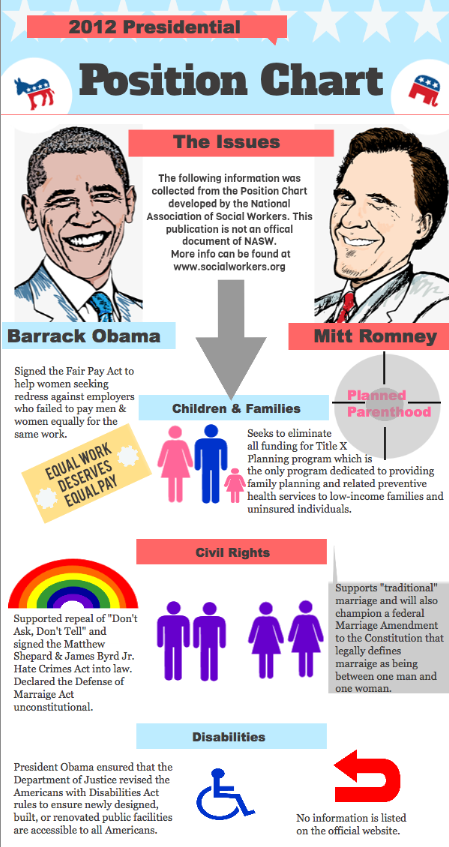
The question remains, what will this look like in social work education? THE ANSWER: I don’t know! I have an idea, but to be honest my idea could totally flop. I think that it is part of what makes this process exciting, the idea of learning from mistakes is incredibly important. However, I do have an example of how the New Media Literacies and Participatory Culture apply to social work education. Essentially my plan is to take a somewhat experiential approach to learning and use the framework to help orient assignments that contribute to the foundation of social work knowledge. These assignments can take on many forms so I will start with an easy example: Advocacy and Awareness. About two months ago, the National Association of Social Workers sent a tweet that contained a link to a document showcasing the 2012 Presidential Candidates position’s on several important areas. You can download a copy of the PACE chart here.
I have to say I was excited that someone had taken the time to put together information from the Candidates on key issues so that I could be a more informed voter. I followed the link and downloaded the chart only to discover several pages of text. Go ahead, download it and see what I am talking about. Knowing what I know about the Internet, I figured people would not be as interested in reading this lengthy, albeit important, document. I wondered why they couldn’t put in a format that was easier to understand, like an infographic. After waiting for a couple of weeks I decided to take the candidate position chart and create an infographic to visually display the information in a more dynamic way.
As you can see, I utilized the skills identified under the New Media Literacies framework to help me design and create this new chart. Unfortunately, I have yet to tweet it out because I have been to busy to finish it. The fact is I do not have extensive knowledge in Photoshop or even in design. I simply used the Internet to get some ideas (networking), experimented (play) with some software on my computer, and translated (visualization) the document into a graphic that captures the eye and draws interest. The next steps, upon finishing, would be to share my creation with others via Twitter, Facebook, or any other social network. Participatory culture, namely a culture with relatively low barriers to artistic expression and civic engagement, support for creating and sharing creations, and the belief that this contribution matters motivated me to engage in this effort. The informal mentorship took place when I watched YouTube videos on how to use a software program to organize and create my Infographic. This is precisely the type of activities that students can easily engage in using digital technologies and more specifically social media. In fact, many students and other individuals already do this.
I understand there are still challenges to engaging in the new digital environment and I’m sure that many will comment on this post highlighting the dark abyss of the Internet and social media that accompanies such unscrupulous activities like cyber-bullying or the anything else that perpetuates negativity. I do not wish to minimize those challenges at all but I do think that if we begin to educate our students about New Media Literacies that we will see positive outcomes. I also believe that as we begin to educate the next generation of social workers who have grown up using social media, we will help them to understand how to use these tools in a way that promotes social justice. Furthermore, just because students have grown up using social media does not necessarily imply they understand how to use it for learning, positive social change, or social work practice. Anecdotally, I have talked with numerous individuals in the human services sector that tell me they need social workers who have a diverse skill set including how to use social media within their organization. We as social workers are ethically obligated to be aware of the changing trends of social practice and to continually learn new ways of helping our clients. We should not shy away from social media, in fact we should embrace it; but only if we can do so using a framework that increases our understanding of how these new skills can help positively impact our practice.
Research is beginning to develop frameworks on how to best use social media, and the normative literature has numerous books and blogs devoted to the subject. The response to social media has been positive and negative. However, social media is not going away as it presents another communication channel to connect with many others. Human service organizations are also beginning to adopt social media and social work educators need to understand how to prepare social work students with the necessary skills for effective social media practice. The key premise is that using social media in the classroom or in the field should not be so focused on what tools to use or what those tools allow, although this is important. Educators need to understand the participatory nature of social media and how new media literacies can compliment social work practice.
But beyond this, my hope is that people will begin to understand the importance of social media, which many have. However, I really think we need to focus more on the critical learning that these tools allow and help our students to use these tools to engage, promote learning, and promote positive social change. But if you still only want to share photos of your last vacation with friends and family, that’s okay too.
If you really want to get an idea of why I think social media can impact social work practice, perhaps I should share with you several of my favorite Ted Talks that have influenced my view of the Internet and what is possible with social media. I created a blog post about this awhile back, which you can access here. I should also include the work of the “Great Explainer” himself, Dr. Mike Wesch, and his Anthropological Introduction to YouTube.
Dr. Wesch also talks about Media Literacy here, but by now I am thinking you have plenty with which to explore 😀
References:
Barnes, N.G., & Mattson, E. (2009). US Charities’ Adoption of Social Media Outpaces All Other
Hackler, D. & Saxton, G. (2007). The Strategic use of information technology by nonprofit organizations: increasing capacity and untapped potential. Public Administration Review, 67(3), 474-484.
Kang, S., & Norton, H. (2004). Nonprofit organizations’ use of the world wide web: Are they sufficiently fulfilling organizational goals? Public Relations Review, 30(3), 279-284.
Kaplan, A. M., & Haenlein, M. (2010). Users of the world, unite! The challenges and opportunities of Social Media. Business Horizons, 53, 59-68.
Kietzman, J. H., Hermkens, K., McCarthy, I. P., & Silvestre, B. S. (2011). Social media? Get serious! Understanding functional building blocks of social media. Business Horizons, 54, 241-251. doi: :10.1016/j.bushor.2011.01.00
Mansfield, H. (2011). Social media for social good: A how to guide for nonprofits. United States: McGraw-Hill.
McNutt, J.G., & Menon, G. M. (2008). The rise of cyberactivism: Implications for the future of advocacy in the human services. Families in Society: The Journal of Contemporary Social Services, 89(1), 33-38. doi: 10.1606/1044-3894.3706
Postman, N. (1970). The Reformed English Curriculum. In A. C. Eurich’s (Ed.), High School 1980; the shape of the future in American secondary education (pp. 160-168). New York, Pitman Publishing Corp.
Sargeant, A., West, D.C., & Jay, E. (2007). The relational determinants of nonprofit web site fundraising effectiveness: An exploratory study. Nonprofit Management & Leadership, 18(2), 141-156.
Saxton, G. D., & Guo, C. (2011). Accountability Online: Understanding the Web-Based Accountability Practices of Nonprofit Organizations. Nonprofit and Voluntary Sector Quarterly, 40(2), 270-295.doi: 10.1177/0899764009341086
Saxton, G. D., & Guo, C., & Brown, W. A. (2007). New dimensions of nonprofit responsiveness:The application and promise of Internet-based technologies. Public Performance & Management Review, 31(2), 144-173. doi 10.2753/PMR1530–9576310201
Waters, R.D. (2007). Nonprofit organizations’ use of the internet: A content analysis of communication trends on the internet sites of the philanthropy 400. NonprofitManagement & Leadership, 18(1), 59-76.
Young, J. (2012). The Current Status of Social Media use among Nonprofit Human Service Organizations: An Exploratory Study. (Doctoral Dissertation). Retrieved from https://digarchive.library.vcu.edu/handle/10156/3775
 This semester I have been engaged in teaching my Social Media, Digital Activism, and eCitizenship course in the traditional face-to-face format (previously it was completely online). This class was also selected as an iPad class, so each of the students either brought their own or were provided an iPad to augment their learning. One of the requirements of the course is to use Twitter to extend our conversations and learning outside the classroom. I have incorporated many assignments and skills from other social work educators, such as Dr. Laurel Iverson Hitchcock (@laurelhitchcock) and Dean Nancy J. Smyth (@njsmyth), as well as using New Media Literacies to help students understand social media. I am always trying to think about how to engage my students in hands on learning through experiential methods. This has involved the use of games, both low tech and high tech, and other methods as well.


 This post is mainly a follow up to a recent twitter chat I had with


 JimmySW