Well I am over 3 weeks into the new semester and more specifically into my Policy class, which has been selected as an iPad class this semester. I haven’t shared much about this as it was really a pretty quick process of applying, getting approval, and revamping my syllabus to address learning with iPads. I hope that as the semester continues I will come back to my blog here and share some of my initial insights. I do have plans to conduct a small evaluation of this project, so details on that will be forthcoming. For now, some initial thoughts as I am almost done with January.
When my course was selected I admit that I was over the top excited for my students. I was excited because I love integrating technology into my courses and being able to have an iPad mini for each student just seemed fantastic. I also kept reminding, and still do, myself that just because I was excited and thought about how each student will use the iPad to augment their learning and bring in relevant policy examples into our class discussions because they have access to the internet in the palm of their hand…That just because of all the potential I imaged, that it did and does not mean my students feel the same. The truth is, and the literature supports this notion, that many students are mystified and nervous about using technology in the classroom. I have asked my class and so far the sentiment of anxiety holds true. Partly for the fear of breaking or losing this free device, and partly because they recognize that they have never used a tablet for learning. I have tried to ease the anxiety by finding and sharing as many resources as possible about the iPad and how to use it. Mainly in the form of YouTube videos embedded in my Blackboard course. I think it has helped but time will tell.
I still have hope that some of the assignments I have designed to maximize the use of the iPad will yield positive learning outcomes, but again time will only tell. I am still excited for the potential that these devices have in my class but I am also quickly realizing that I have my work cut out for me. That is the idea of challenging students’ thinking regarding learning with the iPad. Yes, I do have many students Facebooking through class or checking email or whatever. I don’t plan on implementing a policy stating they have to put the iPads away and pay attention, because the fact is that many students are using their iPads to take notes. I also think that if they are that bored in my class, then I need to engage them more in the discussion directly. I have them using twitter and it is fine if they tweet during class. I have to just keep reminding them to identify the relevance to the course as they do so. This is perhaps one of my first learning moments, which I expected but did not fully recognize. This idea, again, that I need to change their perspective in regards to how to use the iPad for learning rather than just entertainment. Don’t get me wrong, entertainment is good, but I think it can also be educational. Stay tuned for future updates 😀
This post is largely to serve as a follow up to some information I presented at the 2012 Council on Social Work Education Annual Program Meeting. If you stopped by my poster and are now stopping by my blog to get more information about this topic, THANK YOU. Here you will find more information in regards to what Participatory culture is and how the New Media Literacies are critical skills that people should be aware of in their pursuit of social media. I encourage you to watch the videos, follow the links, and seek out more information on this topic as I believe it holds extreme potential to impact social work practice. For those of you who have stumbled upon this blog via some other way, thanks for stopping by, and below is a brief introduction to what I presented at the Conference.
The Abstract:
Social media has transformed the way society is connected and interacts. Government, businesses, and nonprofits are adopting the use of social media by large numbers (Barnes & Matteson, 2009; Kaplan & Haenlein, 2010). However, much of social media in social work centers on the tools and technology of what may or may not be possible. The interaction these tools allow is important but the interactivity is merely a property of the technology. Participation is a property of culture (Jenkins et al., 2009), and is preferred. As one actively participates, one is able to learn new skills and expand critical thinking (Jenkins et al., 2009). A focus on expanding access to new technologies is important, but it only carries us so far if we do not also foster the skills and cultural knowledge necessary to deploy these tools toward more positive ends (Jenkins et al., 2009). Social media can be used to impact social work education by exploring the concept of participatory culture and how new media literacies (Jenkins et al., 2009) can be adopted into the social work curriculum. Results on what nonprofit human service organizations are currently using and doing with social media provide the foundation for why new media literacy should be part of social work education.
Overview of the Literature:
The nonprofit sector has outpaced the public and private sectors in the adoption of social media (Barnes & Matteson, 2009; Barnes, 2011; LaCasse, Quinn, & Bernard, 2010; Young, 2012). Social media is used to demonstrate accountability, engage the community, advocacy, promote the organization and services, as well as for marketing and fundraising. To date, nonprofits have had relatively little success using the internet and many have made recommendations on how to use the internet and social media more successfully (McNutt & Menon, 2008; Sargeant, Saxton & Guo, 2011; Waters, 2007). One study with a large and broad sample indicated 11% of nonprofits identified no goals for using social media (NTEN, 2012). Another study (Young, 2012), highlighted that 62% of human service organizations identified no goals for using social media.
This is really a scant overview of the literature and there is much more to be reviewed. However, you can also read more about my own research, which I have posted here and a follow up here, or you can simply read my dissertation by visiting Virginia Commonwealth University here.
The issue I am trying to discuss with social media and social work is the idea of Participatory Culture and more specifically the New Media Literacies as identified by Henry Jenkins, Ph.D. You can find Dr. Jenkins on Twitter here or view his blog at Confessions of an Aca-Fan.
What is Participatory Culture? Essentially Jenkins defines Participatory Culture as a culture with relatively low barriers to artistic expression and civic engagement, where strong support exists for sharing one’s creations, there is some type of informal mentorship taking place where knowledge is being passed along from experienced to novices. A Participatory Culture is also one in which members believe their contributions matter, and feel some degree of social connection with one another. Participatory Culture is a culture that shifts the focus of literacy from one of individual expression to community involvement.
I am a visual learner and I value Rich Media Content. You can view the video below to see Dr. Jenkins explain in a much more effective way, what Participatory culture is and how it relates to civic engagement.
Although that video focuses more on civic engagement than new media literacies, I think you begin to get more of an understanding about what Participatory Culture is all about. The next video then outlines the New Media Literacies as identified by Henry Jenkins in is white paper Confronting the Challenges of Participatory Culture: Media Education for the 21st Century. A copy of this paper is available for download here.
The New Media Literacies (for those who choose not to watch the video) include:
Play– the capacity to experiment with one’s surroundings as a form of problem solving
Performance– the ability to adopt alternative identities for the purpose of improvisation and discovery
Simulation– the ability to interpret and construct dynamic models of real-world processes
Appropriation– the ability to meaningfully sample and remix media content
Multitasking– the ability to scan one’s environment and shift focus as needed to salient details
DistributedCognition– the ability to interact meaningfully with tools that expand mental capacities
CollectiveIntelligence– the ability to pool knowledge and compare notes with others toward a common goal
Judgement– the ability to evaluate the reliability and credibility of different information sources
TransmediaNavigation– the ability to follow the flow of stories and information across multiple modalities
Networking– the ability to search for, synthesize, and disseminate information
Negotiation– the ability to travel across diverse communities, discerning and respecting multiple perspectives, and grasping and following alternative norms
Visualization– the ability to translate information into visual models and understand the information visual models are communicating as a key method for coping with large data sets and being able to make sense of the complexity of our environment
Again, this framework comes right out of the white paper, which can be accessed via the link in the previous paragraph. You can also access the Project New Media Literacies blog for more information.
The New Media Literacies help us as social workers to further understand the place of social media in our lives. I would also agree with Dr. Jenkins when he explains that it would be better for us to take an ecological perspective regarding this new digital environment. The ecological perspective resonates with us as social workers because it is part of the foundation of our profession. However, I would step back a minute and try to understand this through the lens of Media Ecology, which I briefly touched on in my dissertation research. Neil Postman (1970) explained that media ecology looks into the substance of how media affect human perception, understanding, value, interaction, and whether media facilitates or impedes chances for survival. “The word ecology implies the study of environments: their structure, content, and impact on people” (Postman, 1970, p. 161).
Of course this sounds familiar to us as social workers because we understand how the environment influences our clients, community, and world. I believe that as we take hold of these new digital technologies (specifically social media) that we can use the New Media Literacies as a framework to increase the knowledge of our students and educators. Ultimately, I would view this process as something that happens through collaboration between student and teacher. I think the teacher would essentially act as a guide, while recognizing that students bring valuable experience and knowledge to the process. In fact, this is a process through which I am developing a course for and hope to have going live next fall. Should you know of any social work educators using social media in this way, please leave a comment on this post. I would love to talk with them about their experience.
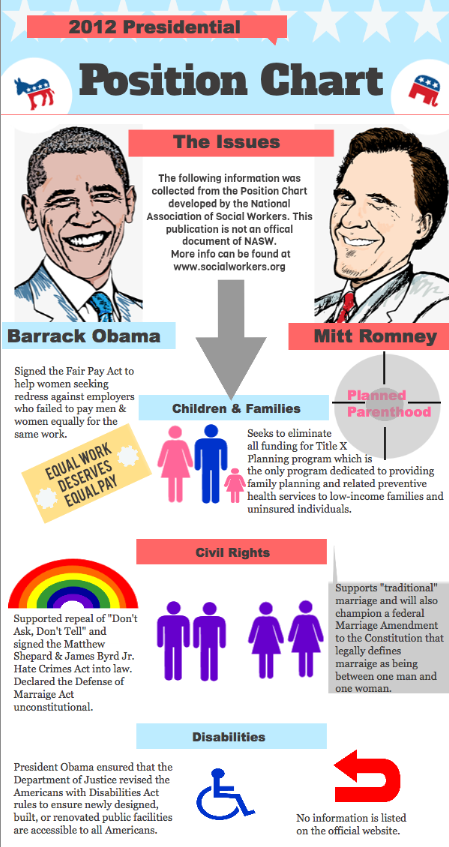
The question remains, what will this look like in social work education? THE ANSWER: I don’t know! I have an idea, but to be honest my idea could totally flop. I think that it is part of what makes this process exciting, the idea of learning from mistakes is incredibly important. However, I do have an example of how the New Media Literacies and Participatory Culture apply to social work education. Essentially my plan is to take a somewhat experiential approach to learning and use the framework to help orient assignments that contribute to the foundation of social work knowledge. These assignments can take on many forms so I will start with an easy example: Advocacy and Awareness. About two months ago, the National Association of Social Workers sent a tweet that contained a link to a document showcasing the 2012 Presidential Candidates position’s on several important areas. You can download a copy of the PACE chart here.
I have to say I was excited that someone had taken the time to put together information from the Candidates on key issues so that I could be a more informed voter. I followed the link and downloaded the chart only to discover several pages of text. Go ahead, download it and see what I am talking about. Knowing what I know about the Internet, I figured people would not be as interested in reading this lengthy, albeit important, document. I wondered why they couldn’t put in a format that was easier to understand, like an infographic. After waiting for a couple of weeks I decided to take the candidate position chart and create an infographic to visually display the information in a more dynamic way.
As you can see, I utilized the skills identified under the New Media Literacies framework to help me design and create this new chart. Unfortunately, I have yet to tweet it out because I have been to busy to finish it. The fact is I do not have extensive knowledge in Photoshop or even in design. I simply used the Internet to get some ideas (networking), experimented (play) with some software on my computer, and translated (visualization) the document into a graphic that captures the eye and draws interest. The next steps, upon finishing, would be to share my creation with others via Twitter, Facebook, or any other social network. Participatory culture, namely a culture with relatively low barriers to artistic expression and civic engagement, support for creating and sharing creations, and the belief that this contribution matters motivated me to engage in this effort. The informal mentorship took place when I watched YouTube videos on how to use a software program to organize and create my Infographic. This is precisely the type of activities that students can easily engage in using digital technologies and more specifically social media. In fact, many students and other individuals already do this.
I understand there are still challenges to engaging in the new digital environment and I’m sure that many will comment on this post highlighting the dark abyss of the Internet and social media that accompanies such unscrupulous activities like cyber-bullying or the anything else that perpetuates negativity. I do not wish to minimize those challenges at all but I do think that if we begin to educate our students about New Media Literacies that we will see positive outcomes. I also believe that as we begin to educate the next generation of social workers who have grown up using social media, we will help them to understand how to use these tools in a way that promotes social justice. Furthermore, just because students have grown up using social media does not necessarily imply they understand how to use it for learning, positive social change, or social work practice. Anecdotally, I have talked with numerous individuals in the human services sector that tell me they need social workers who have a diverse skill set including how to use social media within their organization. We as social workers are ethically obligated to be aware of the changing trends of social practice and to continually learn new ways of helping our clients. We should not shy away from social media, in fact we should embrace it; but only if we can do so using a framework that increases our understanding of how these new skills can help positively impact our practice.
Research is beginning to develop frameworks on how to best use social media, and the normative literature has numerous books and blogs devoted to the subject. The response to social media has been positive and negative. However, social media is not going away as it presents another communication channel to connect with many others. Human service organizations are also beginning to adopt social media and social work educators need to understand how to prepare social work students with the necessary skills for effective social media practice. The key premise is that using social media in the classroom or in the field should not be so focused on what tools to use or what those tools allow, although this is important. Educators need to understand the participatory nature of social media and how new media literacies can compliment social work practice.
But beyond this, my hope is that people will begin to understand the importance of social media, which many have. However, I really think we need to focus more on the critical learning that these tools allow and help our students to use these tools to engage, promote learning, and promote positive social change. But if you still only want to share photos of your last vacation with friends and family, that’s okay too.
If you really want to get an idea of why I think social media can impact social work practice, perhaps I should share with you several of my favorite Ted Talks that have influenced my view of the Internet and what is possible with social media. I created a blog post about this awhile back, which you can access here. I should also include the work of the “Great Explainer” himself, Dr. Mike Wesch, and his Anthropological Introduction to YouTube.
Dr. Wesch also talks about Media Literacy here, but by now I am thinking you have plenty with which to explore 😀
References:
Barnes, N.G., & Mattson, E. (2009). US Charities’ Adoption of Social Media Outpaces All Other
Hackler, D. & Saxton, G. (2007). The Strategic use of information technology by nonprofit organizations: increasing capacity and untapped potential. Public Administration Review, 67(3), 474-484.
Kang, S., & Norton, H. (2004). Nonprofit organizations’ use of the world wide web: Are they sufficiently fulfilling organizational goals? Public Relations Review, 30(3), 279-284.
Kaplan, A. M., & Haenlein, M. (2010). Users of the world, unite! The challenges and opportunities of Social Media. Business Horizons, 53, 59-68.
Kietzman, J. H., Hermkens, K., McCarthy, I. P., & Silvestre, B. S. (2011). Social media? Get serious! Understanding functional building blocks of social media. Business Horizons, 54, 241-251. doi: :10.1016/j.bushor.2011.01.00
Mansfield, H. (2011). Social media for social good: A how to guide for nonprofits. United States: McGraw-Hill.
McNutt, J.G., & Menon, G. M. (2008). The rise of cyberactivism: Implications for the future of advocacy in the human services. Families in Society: The Journal of Contemporary Social Services, 89(1), 33-38. doi: 10.1606/1044-3894.3706
Postman, N. (1970). The Reformed English Curriculum. In A. C. Eurich’s (Ed.), High School 1980; the shape of the future in American secondary education (pp. 160-168). New York, Pitman Publishing Corp.
Sargeant, A., West, D.C., & Jay, E. (2007). The relational determinants of nonprofit web site fundraising effectiveness: An exploratory study. Nonprofit Management & Leadership, 18(2), 141-156.
Saxton, G. D., & Guo, C. (2011). Accountability Online: Understanding the Web-Based Accountability Practices of Nonprofit Organizations. Nonprofit and Voluntary Sector Quarterly, 40(2), 270-295.doi: 10.1177/0899764009341086
Saxton, G. D., & Guo, C., & Brown, W. A. (2007). New dimensions of nonprofit responsiveness:The application and promise of Internet-based technologies. Public Performance & Management Review, 31(2), 144-173. doi 10.2753/PMR1530–9576310201
Waters, R.D. (2007). Nonprofit organizations’ use of the internet: A content analysis of communication trends on the internet sites of the philanthropy 400. NonprofitManagement & Leadership, 18(1), 59-76.
Young, J. (2012). The Current Status of Social Media use among Nonprofit Human Service Organizations: An Exploratory Study. (Doctoral Dissertation). Retrieved from https://digarchive.library.vcu.edu/handle/10156/3775
Okay, well it has been a very long and exciting summer and things are settling down a little bit with my new job so I figured I better come back to finish the write up on my dissertation. Previously I provided the results of the study examining the current status of social media use among nonprofit human service organizations, which you can find here. Now at the request of a fellow @VCUsocialwork PhD alum (@Jon_Singletary) and his current community organizations class, I have decided to include the implications of my study along with a bit of a discussion. I am going to try and stick to what I wrote in my dissertation since I have since become a little burnt out on the topic, which I hear is understandable. In all actuality, I am still pretty excited about this topic 😀
The following is from the last chapter of my dissertation and since I own the copyright I figure I can post it here without any repercussions.
The current status of social media use among nonprofit human service organizations is that HSO’s initially adopted social media to engage with the community. Although many HSO’s continue to do this, promoting the HSO’s programs and services has also become a top priority. This is primarily done using Facebook, Twitter, and YouTube to share organizational newsletters, photos from projects, links to the HSO, and other information with their online community at least twice a day. Human service organizations have been using social media for more than five years and most plan to continue using social media in the future. Although HSO’s reported using social media less than ten hours a week, they were generally satisfied with the outcomes but admitted more assistance is needed.
Although the current status of social media use among HSO’s appears promising, many aspects of using this new medium require more attention. The evidence in this study may not confirm whether the digital divide of social media among HSO’s is decreasing or increasing; however, the study does suggest that HSO’s could benefit from additional assistance. McNutt & Menon (2008) argue the digital divide is particularly problematic where “situations of e-government activity has increased technological hurdles for participating in rule making and lobbying the legislature” as organizations may be left behind (p. 37). Expanding knowledge and technological capacity may be the first steps to closing the gap.
The digital divide is an important implication to consider when thinking about the participatory culture of social media. Henry Jenkins (2006) explains that focusing on expanding access to new technologies only takes one so far if there is not also a contemporaneous fostering of the skills and cultural knowledge necessary to deploy these tools towards certain ends. Access is important, but the development of a new skill set and knowledge is equally significant. This development stems from interaction via individuals using social media to work with a networked mindset, acting on the principles of openness, transparency, decentralized decision-making, and distributed action (Scearce, Kasper, & Grant, 2009). This is the social media ecology concept discussed in chapter one, which involves the platforms such as Facebook and Twitter, but also involves the user-generated activity of participatory culture to share information, connect with others for peer-to-peer learning opportunities, and a more empowered conception of citizenship. Closing the digital divide will be a multifaceted effort, but the use of social media and the participatory culture that it engenders will undoubtedly help to shrink the gap.
A second implication of this study is the need to think strategically about how to use social media. Many social media experts (Kanter & Fine, 2009; and Mansfield, 2011) assert the variety of benefits of using social media in the nonprofit sector. However, little empirical evidence exists that examines human service organizations directly. This study represents one of the first attempts to fill this gap in the literature and provide a foundation for future inquiry. Increased understanding of the current status of social media use among HSO’s will aid in assisting organizations with defining goals and thinking strategically about fundraising, promoting the organization, increasing transparency and accountability, as well as how to engage the community and support the organization in a way that is mutually beneficial.
The evidence from this study indicates a strategic social media plan should begin with a discussion around how to use social media and who should be involved. This means identifying who or how many individuals are responsible for the social media activities of the HSO and determining the best way to balance promoting the organization with community engagement so as to foster trust and maintain a genuine connection with the community. Respondents within this study seem to understand that social media users do not simply want advertisements, but rather real interaction with the organization. This can be done through transparency and accountability in addition to thinking creatively about community engagement. Finally, a discussion about how or whether to engage in fundraising via social media should also accompany a strategic social media plan so that precious resources are not wasted on efforts that result in diminutive dividends. Online fundraising is becoming increasingly fruitful and important (Ingenhoff & Koelling, 2009; and Rosenburg, Rooney, Steuerle, & Toran, 2011) ), but respondents in this study seem to understand that cultivating a genuine relationship with their online community will have greater dividends for the HSO in the long term.
The current status of social media use among HSO’s validates how technology is changing the way people interact. This has a profound impact on HSO’s as well as social work practice. McNutt & Menon (2008) argued, “social work advocates cannot ignore the promise that cyberspace and technology offers” (p. 38). This study demonstrates that social media cannot be ignored and that it encompasses more than just advocacy. One of the main tenets in social work is about creating connections and empowering vulnerable and oppressed populations. Social media offers these opportunities for those who care about social justice issues to empower others, share meaningful stories, raise awareness about particular issues, and to connect with others in more powerful ways. This connection is not meant to supplant the traditional face-to- face interaction, rather it is meant to support and enhance it. This is happening right now with the flow of content across multiple media platforms, which encourages people to seek out connections, new information, and to move towards a participatory culture. This is the cultural shift of convergence described by Henry Jenkins (2006). This study illustrates the profound motivation for adopting social media as respondents recognize the incredible potential for connecting with individuals and increasing community engagement for the greater good.
The power of social media and participatory culture resides within the people who are passionate enough to mobilize and respond to an issue. The ideological underpinnings of social media combined with the social purpose of HSO’s explain why this combination is a natural fit. The social media ecology and participatory culture described in chapter one encourage sharing, learning, openness, and impact individuals in deep and meaningful ways through the creation of trust and empowerment. Human service organizations also work to create trust and empower those whom they serve. Obviously this can only be done when the tools are used in an appropriate manner. However, this is one of the greatest and most exciting aspects of this new medium.
This study provides a foundation to explore best practices and offer suggestions for future research. The fact that a number of human service organizations are using social media and believe it to be valuable is an indication that this area of inquiry is important to social work practice, administration, and advocacy. The path of social media in social work holds incredible potential and should not be diminished or simply relegated to other professions. Others use this new medium and social work cannot afford to be left behind. The ecology of social media represents a new paradigm of building community, empowering others, developing a new skill set, and connecting for the greater good.
Wow, I actually haven’t read that since I defended my dissertation last spring and it is actually pretty good. In the months sense I have started to delve into more of Henry Jenkins work around participatory culture and I am currently reading Howard Rheingold‘s new book Net Smart. I’m interested in understanding more about how social media can help nonprofit organizations, but I am equally interested in helping social workers understand how social media, the tools and the practices, can help with macro-level social work. Inherent in this should be a basic understand not only of the technology, but what it means to participate in the digital environment. You can check out Jenkins and Rheingold for more information around that, but that is essentially where I would like to go next.
I am also interested in knowing if or how many schools of social work currently incorporate social media into their macro practice courses. I know I am and that Jon is at Baylor U., but what else is being done? (Jon if you are interested in partnering on this topic just let me know lol). I see major implications, mostly positive but also some negative, for integrating social media into this realm of social work practice. I have some ideas on where to start, which I will be sharing at CSWE in November so if you will be there please stop by. Okay, I generally try to keep things short and I have gone on with this post. As always, please contact me if you have any questions or leave a comment on this post. You can always contact me via twitter @JimmySW. Thanks.
If you haven’t yet seen or joined socialworkhelper.com, you should head over there as soon as you finish reading this post. This website was built by a social worker for social workers and contains many valuable resources on a myriad of topics relating to social work. Deona has done a great job in creating this resource and integrating social media apps and other tech innovations such as instant messaging and video chats.
A fair amount of social workers are already using the site and posting some great information and more importantly, connecting for the greater good. Once you have created an account, you can begin posting information and or consuming what has already been posted on the site. There are areas for clinicians, students, macro social workers, and even unconventional social workers…But aren’t we pretty much all unconventional 😀
I truly believe that this site is one of the first comprehensive online communities for social workers. It is free to sign up, so head on over and take a look around at socialworkhelper.com.
Well I guess that something had to ignite the fire enough within me to finally come back and write a blog post again in the midst of dissertating. I’m nearly done with the dissertation and plan to post many results here on my blog. This is also the reason for this post, or the fact that NTEN/ Blackbaud/ Common Knowledge just released their 2012 Nonprofit Social Networking Benchmark Report. There is a wonderful Infographic, which sums up the report nicely and the link will also help you download the full report.
I have to say that the information is great. I am so glad that this data is being compiled and I have built a survey instrument using similar questions to these folks for my dissertation. I also compiled my data during the same time period, but with a much smaller sample that was focused on Nonprofit Human Service Organizations. I focus on these unique organizations because of their important roles in society and NO research has looked at how they use social media.
The Benchmark report and my dissertation have many things in common. This makes me smile because it indicates that my findings are generalizable. However, I do have some problems with the recent Report. The main problem is around their methodology. I understand they only solicited and primarily reported descriptive data, but they do not explain this in the report. They have a small section on their methods but nothing beyond that. This is critically important because of how the data is being used in practice. For all we know, the methods they used could be based upon incorrect statistical principles which would nullify all of the findings. I don’t think this has happened, but in a sector which promotes transparency I would think they would have no problem in divulging their methodology.
This is also important considering the new statistic they are reporting around the cost of a follower on Twitter and a Like on Facebook. They indicate that these numbers are based upon self-report and that respondents have different ways of calculating this cost. I would be extremely cautious when looking at this statistic and thinking about basing some budget decisions around this because there is no clear indication of how the number was developed. It is a good statistic, just not one I am very confident in.
I am defending my dissertation in a little over a week and will likely begin to disseminate my own findings after that date. This is mostly to help the community where I collected my data, but it will also help many other nonprofit human service organizations think about their own social media strategies, planning, and implementation.
I have been sitting on this idea for nearly a year now and I have finally decided to follow up with it. Taking inspiration from @SWSCmedia I hope to further the discussion around social media and social work by connecting social workers through social media. Right now it is pretty small, mostly existing on twitter, but via the SM4SW blog. I hope that anyone who is interested in social work and the intersection of social media will join in our chats by using #SM4SW. You can also follow @SM4SW to engage in the discussion. I would encourage anyone interested in any part of social work to come and join. From the seasoned practioner to the still undecided social work student. I hope that this dialogue will help many excited about social media, social work, and positive change.
This post is meant to share some of my favorite TED talks with @HildyGottlieb who asked me to share with her via twitter. Because of the limited number of characters and the fact that there are so many talks I like, I thought I would post them here, for all to enjoy.
I was hoping to get a bit of help from some of my readers and followers in defining social media use by the number of updates a user posts to their social media profiles. The results of this brief poll will actually inform a similar type of question on a survey I have developed for my dissertation, so your help is much appreciated. Also if you disagree with my scales of Light, Medium, and Heavy, then please leave a comment explaining what might be a more appropriate way to determine someones social media use in a given day. Thanks!
Yesterday I was fortunate enough to give a couple of workshops on Technology and Social work. I am linking my presentation, which I did in Prezi and apparently cannot embed in wordpress, here. The workshop was part of the 31st Annual Rally in the Valley BSW Student Conference entitled “Leadership for the Millennial Social Worker.” This conference was sponsored by Virginia Social Work Education Consortium and NASW, Virginia Chapter.
I thought the workshops were great, despite a few technical glitches, but then again, what would a workshop on Technology be without some tech-hang ups, right? At any rate, I fully enjoyed working with the students and I hope they also enjoyed what I shared with them. Be sure to check out that link above or here below, for my prezi on this workshop. An internet connection is needed to play the videos 😀
I’ve been invited to lead a workshop on technology and social work for BSW conference in October and I’m wondering what would be some good topics to incorporate? I plan on talking about the various social media tools and how they can be used by BSW students entering the workforce, for instance LinkedIn for networking, and I’m going to discuss some various tech tools that I think could be used easily in practice, such as Smartphones for taking case notes. This is nothing new as the folks at the University of Minnesota featured a conference on technology and social work practice among Child welfare workers several months ago. They also put together a publication referencing various studies other resources on technology in practice. You can find CW360 by clicking here.
I also thought about moving along the micro-macro continuum and where technology fits in, but I have yet to develop that thought any further. So I simply wanted to pose the question to you. What would you do? What do you think BSW students need to learn about technology and social work? I look forward to your comments/suggestions.


 JimmySW